
Homepage > Compositions > Music Datasheet
"Bouncing the Beat"
| GENERAL INFORMATION | |
|---|---|
| Title | Bouncing the Beat |
| Composer | F.G.J. Absil |
| Instrum. | Concert Band/Fanfare (feature for solo baritone and tuba) |
| Date | 21 February 2003 |
| Duration | 5'30 |
| Style | Swing (bounce) - Latin Rock |
| Key | Ab - Bb |
| Meter | 4/4 |
| Measures | 167 |
| Tempo | 120 BPM |
| Grade | 5 |
FULL INSTRUMENTATION
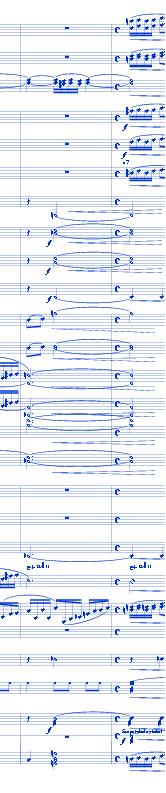
CONCERT BAND VERSION:
- Piccolo, Flute 1-2, Oboe 1-2, Bassoon 1-2, Eb Clarinet, Bb Clarinet 1-2-3, Bass Clarinet;
- Alto Saxophone 1-2, Tenor Saxophone 1-2, Baritone Saxophone;
- French Horn 1-2-3-4, Trumpet 1-2-3-4, Trombone 1-2-3-4 (1st Trombone solo), Baritone 1-2, Tuba (Eb and Bb Bass);
- Jazz Guitar, Piano, Bass Guitar, Drums;
- Timpani, Percussion (2 players: bar chimes, congas, cowbell, guiro, shaker), Mallets (marimba, vibraphone).
FANFARE BAND VERSION:
- Soprano Saxophone, Alto Saxophone 1-2, Tenor Saxophone 1-2, Baritone Saxophone;
- Bugle in Eb, Flugelhorn 1-2-3, Horn in F 1-2-3-4, Trumpet 1-2-3-4;
- Baritone 1-2, Euphonium, Trombone 1-2-3-4 (1st Trombone solo), Eb Bass, C Bass;
- Jazz Guitar, Piano, Bass Guitar, Drums;
- Timpani, Percussion (2 players: bar chimes, congas, cowbell, guiro, shaker), Mallets (marimba, vibraphone).
NOTES FOR THE PERFORMER
This piece for fanfare or concert band, entitled Bouncing the Beat, is in medium tempo. It will feature the bass part players in the band (they must be fairly skilled). The style is twofold: sections in swing are juxtaposed with sections in 16th latin-rock style. The dotted 8th plus 16th figure indicates that the swing is strongly accented (bouncing style).
The piece is in three-part form (mm. 1-60, 61-123, 124-167). The introduction is followed in m. 9 by the main theme in A-B-A-B form (the A-part in swing style, the B-part of the sentence in latin rock style). After a transition (mm. 49-60) there is a 2-part solo in parallel 10ths (mm. 60-79 and mm. 89-96) for the lower brass (tuba, baritone and euphonium) and bass guitar. This should not be played by the full section; feature your best instrumentalists (up to 2 players per part). Play a relaxed swing (triplet feeling) during the solo and apply the rest of the band for colouring the backgrounds. Occasionally there are snippets of double time feeling for the soloists and in m. 89 the style changes into latin with a climax in mm. 97-106.
After the transition (mm. 116-123) the main theme returns, but now in the new key of Bb. The piece concludes with a coda (mm. 157-167), where there is a final solo line (mm. 157-166) before everybody settles down in a tranquil cadense.