
Homepage > News items (2026) - (2025) - (2024) - (2023) - (2022) - (2021) - (2020) - (2019) - (2018) - (2017)
Monthly news items, video links and blog on the Frans Absil Music website
News Archive
July 2026: Patreon revived, two video tutorials on Schillinger Harmony of Fourths.
 After a year of silence I revived my Patreon account. I was so disappointed by Patreon tier members who were basically freeloading hundreds of high quality PDF content, then cancelling the subscription, that I considered closing this account for good. However Patreon has updated its tools and I'll give it another try. I put the YouTube tutorial companion documents also in the Patreon shop and introduced a fresh membership tier. Find my Patreon at https://patreon.com/fransabsil. I do welcome the support.
Learning about Schillinger Harmony of Fourths is now possible with two video tutorials (will become a three-part series) uploaded to my YouTube channel. The subject is covered in the Schillinger System of Musical Composition, Book 9 (General Theory of Harmony), Chapter 5.
Episode 1 follows the original chapter content, but with fresh examples in various diatonic keys.
 There are six harmonic continuities for trichords and 27 for tetrachords in fourths. All progressions use constant positive root cycle and a limited subset of transformations (clockwise, counterclockwise and crosswise voice leading). Watch
Schillinger Harmony Of Fourths Part 1: The Fundamentals (29:20).
There are six harmonic continuities for trichords and 27 for tetrachords in fourths. All progressions use constant positive root cycle and a limited subset of transformations (clockwise, counterclockwise and crosswise voice leading). Watch
Schillinger Harmony Of Fourths Part 1: The Fundamentals (29:20).
Episode 2 goes beyond the original book chapter.
 In 20 harmonic continuities and 11 instrumental form examples I demonstrate the potential for writing chords in fourths progressions when introducing variable root cycles, transformations, key and mode, and part density. This is presented in
Schillinger Harmony Of Fourths Part 2: The Extensions (35:53).
In 20 harmonic continuities and 11 instrumental form examples I demonstrate the potential for writing chords in fourths progressions when introducing variable root cycles, transformations, key and mode, and part density. This is presented in
Schillinger Harmony Of Fourths Part 2: The Extensions (35:53).
You'll find an overview of all videos on the YouTube video tutorials page (descriptions and links).
<< Previous - Top of page - Next >>
March 2026: Schillinger System and other video tutorials.
Here's an update on recent video tutorials uploaded to my YouTube channel.
There's a three-part series on variation techniques through geometrical inversions,
 as discussed in the Schillinger System of Musical Composition. Create a melodic or harmonic continuity, using the original plus the fundamental variation forms inversion, retrograde, and retrograde-inversion. Watch
Geometrical Inversion Variation in the Schillinger System, Part 1: Melody (16:43), for a focus on melody only.
as discussed in the Schillinger System of Musical Composition. Create a melodic or harmonic continuity, using the original plus the fundamental variation forms inversion, retrograde, and retrograde-inversion. Watch
Geometrical Inversion Variation in the Schillinger System, Part 1: Melody (16:43), for a focus on melody only.
In the second episode we look at the combination of melody and harmony:
 Geometrical Inversion Variation in the Schillinger System, Part 2: Melody with Accompaniment (16:27). Learn about the optional changes in the part stacking order, obtain a better bass part, and how to improve the voice leading in the harmony parts, using the nearest note approach.
The final episode in this series is entitled:
 Geometrical Inversion Variation in the Schillinger System, Part 3: Continuity of Melody with Harmony (24:01), where we create longer continuities of harmony and melody, with contrasting phrases. Use additional musical composition elements such as pedal point, melodic forms and orchestration.
The next video shows how to transfer a MIDI Groove pattern in the Superior Drummer 3 (SD3)
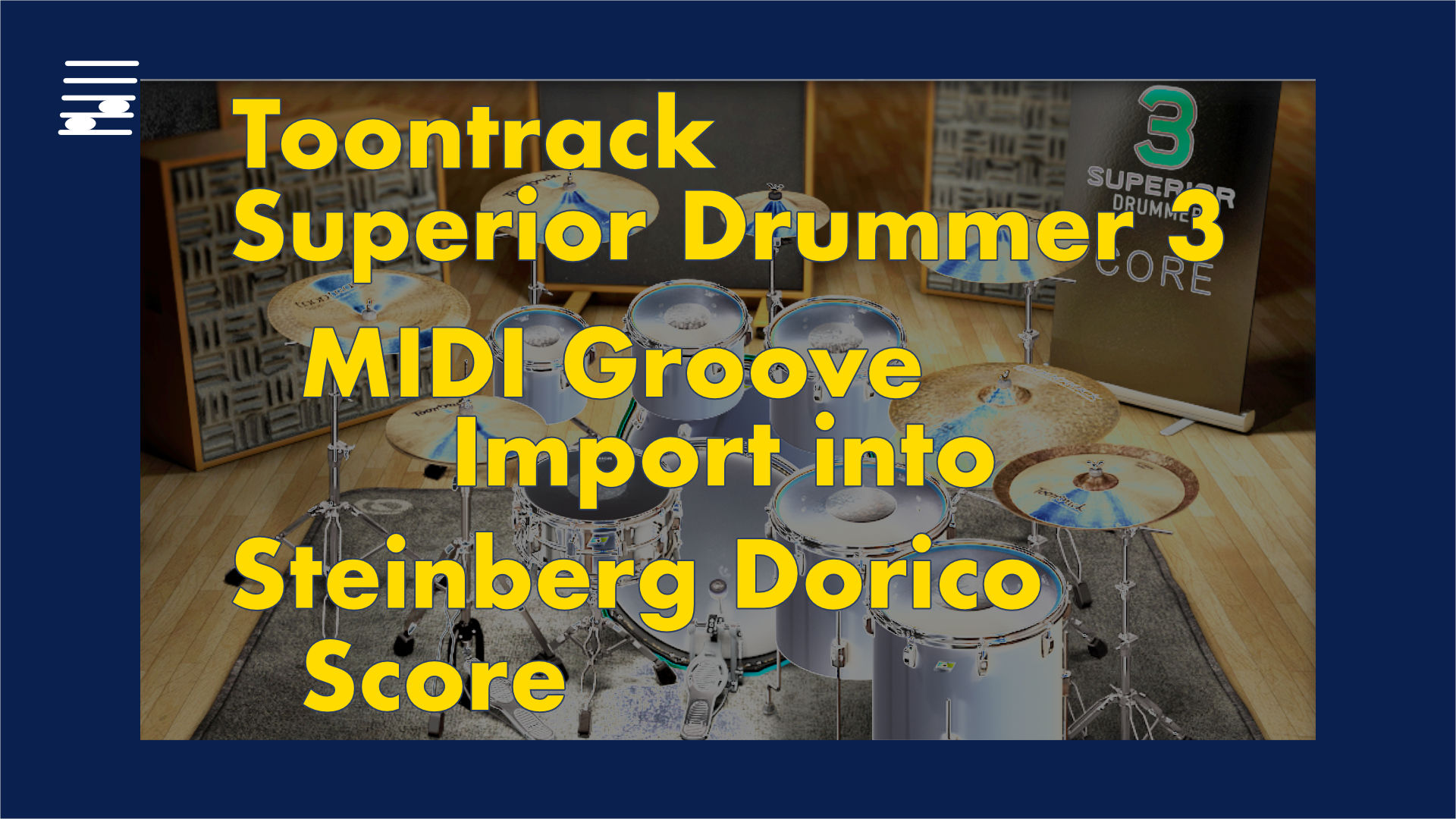 browser and copy that file over into the Dorico music notation software. The goal is to obtain correct drum set staff notation in the score and audio playback.
In
Toontrack Superior Drummer 3 MIDI Groove Import Into Steinberg Dorico Score (14:26)
watch the detailed setup in SD3 and Dorico and use this approach to create a drum track for your MIDI score mockup, maintaining the feel and dynamics from the original drum groove patterns.
browser and copy that file over into the Dorico music notation software. The goal is to obtain correct drum set staff notation in the score and audio playback.
In
Toontrack Superior Drummer 3 MIDI Groove Import Into Steinberg Dorico Score (14:26)
watch the detailed setup in SD3 and Dorico and use this approach to create a drum track for your MIDI score mockup, maintaining the feel and dynamics from the original drum groove patterns.
<< Previous - Top of page - Next >>